In a brief announcement on its Facebook page, Greek NGO MOm today announced that the orphaned monk seal pup rescued from Naxos on 19 September had died in its rehabilitation unit on Alonnisos.
The statement reads in part: “[The pup] had unstable temperature and sugar levels and died in the afternoon of Friday, October 5th. Pending the results of the necropsy that took place yesterday at the Pathological Laboratory [sic] of the Aristotle University of Thessaloniki and the responsible veterinarian Dr. Anastasia Komninou, it was found that there was a generalised inflammation of the intestine, pneumonia and severe parasitic load. We expect more detailed information from the results of the virological, bacteriological and histological tests.”
Photo Courtesy Thomas Lienenbröker and Thomas Sebralla
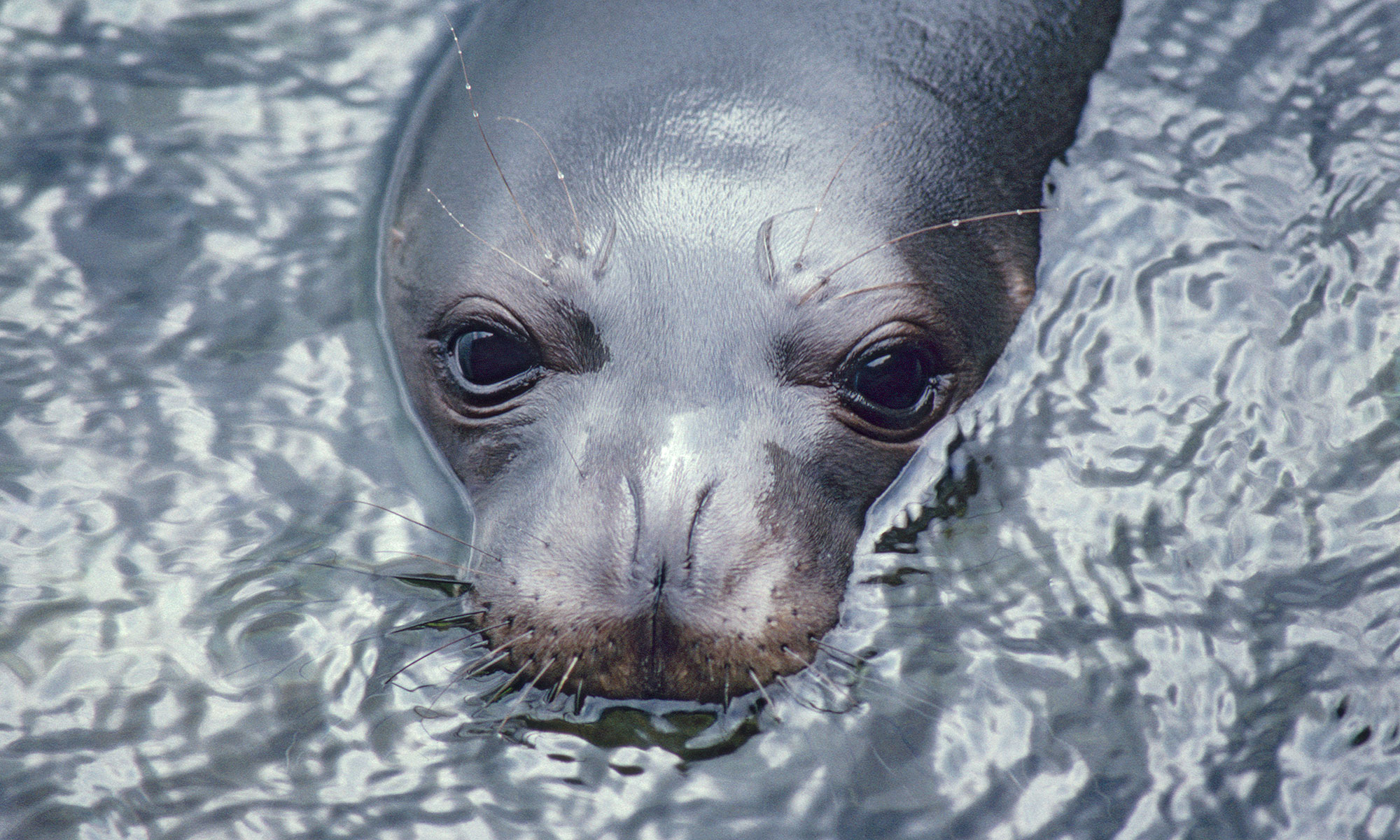
A Mediterranean monk seal pup, possibly separated from its mother following rough weather earlier in the week, has been rescued on the Cycladic island of Naxos. It was taken into care and evacuated to Athens on 20 September by the Greek NGO MOm, the Hellenic Society for the Study & Protection of the Monk Seal.
Two German visitors to Naxos alerted TMG of the stranding, describing the young seal as approximately 1-1.2 meters in length with characteristic white belly patch. Their first sighting occurred at around 12:00 noon on Wednesday 19 September at Agia Ana, where their curiosity was aroused by the presence of a small crowd at the harbour beach.
“When we got closer,” Thomas Lienenbröker and Thomas Sebralla reported, “we realized that there was a small seal trying to crawl onto the beach. […] There were about maybe 10 people around, of which two Greeks tried to make the seal crawl back into the water. One of them grabbed the seal by its tail and took it a few meters into the sea. It swam a couple of meters and then tried to get back onto land again, a couple of meters further down the beach. We asked if anyone had called for help, and we were told that the coast guard had been informed.”
Returning to the scene at around 18.00, there was again an assembled crowd, this time including two coast guard officers. The pup, reported Lienenbröker and Sebralla, could be seen “under a bushy tree in the shade… seemingly exhausted, but alive.”
Concluding that the seal was now in safe hands, the two men left to catch the bus. “On leaving we noticed the coast guard heading towards their car and leaving the scene, with more than 25 people standing around the seal. Waiting for the bus we then could see someone grabbing the seal and taking it back into the water. It swam a short while and then tried to get back onto land again. When we left on the bus the seal had made its way back up onto the beach, with even more people looking on.”
Although the Coast Guard and Port Police form an integral part of the RINT monk seal rescue network in Greece, this case appears to demonstrate how important it would be for some designated authority to control the scene of a stranding, ensuring the appropriate measures are taken, and misguided intrusions by the public prevented.
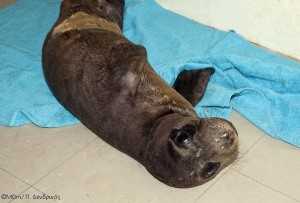
Under care in Athens. Photo courtesy MOm
Unless indicated otherwise by expert guidance, members of the public should not approach a stranded monk seal, but keep it under observation from a distance, reporting its presence to the Port Police, or directly to MOm, the NGO which administers the RINT. Under no circumstances should the animal be touched or manhandled — factors likely to increase stress and worsen its condition, as well as jeopardising any possibility of an abandoned pup being reunited with its mother.
The 3-week old Naxos pup was described as weak and dehydrated by MOm as it arrived in Athens on Thursday, en route to Alonnisos where the organisation still operates a dilapidated 20 year old rehabilitation cabin, in much need of renewal or replacement.
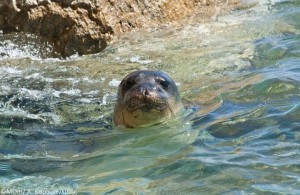
On Saturday April the 7th, young “Fokionas”, the Mediterranean monk seal found at Syros on the 16th of February, returned back to his natural environment. After almost two months in the Rescue and Rehabilitation Centre of MOm in Alonnisos, a healthy and strong “Fokionas” was released in to the National Park of Alonnisos Northern Sporades.
When found at the age of three months, “Fokionas” was weak, very dehydrated, in a bad dietary condition and weighed merely 23 kg. His transport to the Rescue and Rehabilitation Centre of MOm in Alonnisos was deemed necessary in order to ensure his survival.
Under the supervision of the experts of MOm and the veterinarian in charge, “Fokionas” followed a specialized and intensive rehabilitation program that aimed in treating an infection and the parasites that had befallen him. Already from the first days of the treatment “Fokionas” responded positively and ate whole fishes, as he had stayed long enough with his mother to learn the basic feeding and hunting skills.
Upon release, “Fokionas” had reached a body weight of 58 kilos, while all veterinary examinations indicated that he is in an excellent health condition. It should be noted that “Fokionas” was one of the strongest and wildest pups to enter rehab at the Rescue and Rehabilitation Centre of MOm.
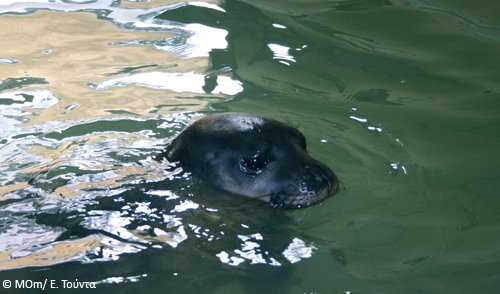
In a brief announcement on its Facebook page, Greek NGO MOm has announced that monk seal pup ‘Fokion’, currently in rehab on Alonnisos, now weighs more than 40 kilos, eats 5 kilos of fish 3 times per day, and is almost ready for release. Fokion was rescued in February on the island of Syros.
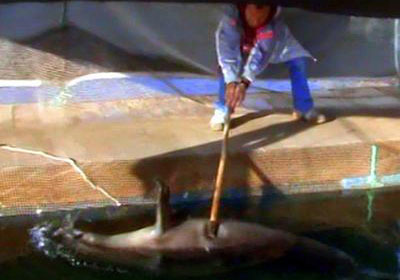
According to Turkish press reports, the veterinarian charged with beating orphaned monk seal Badem during an ill-conceived ‘aversion therapy’ programme, has received a court sanctioned fine of 848 TL. (approximately $470). It remains unclear whether the Foça town abattoir vet, Avni Gök, will be banned from future monk seal rehabilitations.
In response to questions from TMG, Turkish monk seal NGO SAD-AFAG, responsible for Badem’s rescue and on-again, off-again rehabilitation, insisted that it had neither approved nor was aware of the veterinarian’s training regime, video footage of which sparked widespread public anger. While condemning the actions of Gök, AFAG’s Cem Orkun Kirac suggested that the footage had been leaked by local opponents of AFAG rehabilitation projects, and that the veterinarian’s methods had not been inspired by cruelty or malice.
TMG’s opinion is that the training regime applied was at best driven out of ignorance and at worst represents a clear case of inexcusable animal cruelty. While Hawaiian monk seal researchers occasionally employ “aversive conditioning” to drive monk seals away from situations in which they or members of the public are deemed at risk, (1) these are applied within the specific situation in which such action is required, not in an enclosed pool where no such risk exists, and (2) utilise actions such as noise, lights or “waving a palm frond” at the animal — presumably not quite in the same league as beating it with a stick.
We understand that AFAG intends to issue an English language press release on the issue within a matter of days.
Jenkinson, E. M. 2010. Aversive conditioning and monk seal – human interactions in the main Hawaiian Islands: Aversive Conditioning Workshop, Honolulu, Hawaii, November 10-11, 2009. U.S. Dep. Commer., NOAA Tech. Memo., NOAA-TM-NMFS-PIFSC-25, 28 p. + Appendices. [PDF 268 KB]
 In a brief announcement on its Facebook page, Greek NGO MOm today announced that the orphaned monk seal pup rescued from Naxos on 19 September had died in its rehabilitation unit on Alonnisos.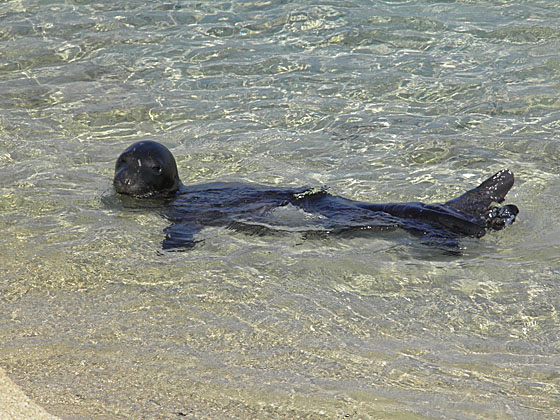
 In a brief announcement on its
  According to Turkish press reports, the veterinarian charged with beating orphaned monk seal Badem during an ill-conceived ‘aversion therapy’ programme, has received a court sanctioned fine of 848 TL. (approximately $470). It remains unclear whether the Foça town abattoir vet, Avni Gök, will be banned from future monk seal rehabilitations.